
Local SEO is everything that makes your business show up when someone nearby searches for what you offer: in the map pack at the top of Google, in searches like “electrician Koblenz” or “restaurant near me”, and on Google Maps. It matters more in 2026 because AI assistants such as ChatGPT, Gemini and Perplexity now answer questions like “Who is the best dentist in Split?” themselves, using the same signals: your Google Business Profile, reviews, website and what others say about you.
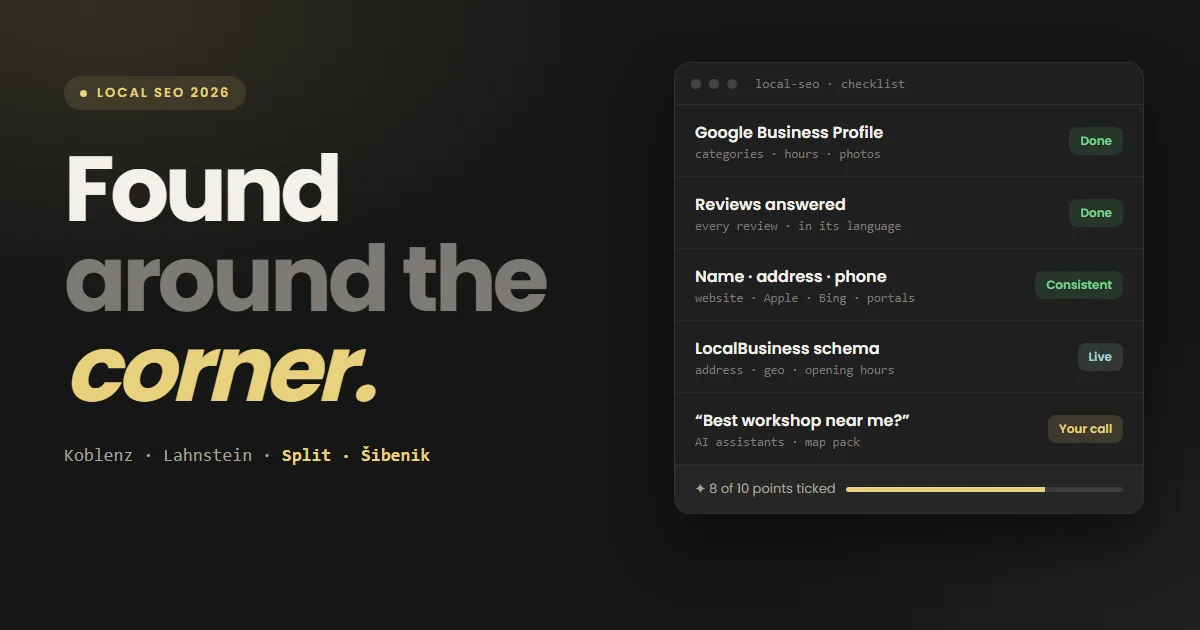
Google names three factors for local results: relevance, distance and prominence. You cannot move your premises, but you can work on the other two. Here is the local SEO checklist we use, on the Rhine near Koblenz as on the Adriatic coast.
The local SEO checklist for 2026
1. Google Business Profile, done properly
Many customers see your profile before your website, so treat it like a second homepage:
- Categories: one precise primary category for your core business, plus secondary categories for what else you really do. The primary category carries the most weight.
- Services and products, described in your customers’ words.
- Opening hours including public holidays and, for seasonal businesses, the off-season. Wrong hours are a quick way to earn a bad review.
- Real photos of your premises, team and work. No stock images.
- Posts with news, offers and events.
- Q&A: where your profile still has this section, answer common questions yourself. Where Google answers with AI, it draws on your profile, website and reviews, so keep all three complete.
- Booking, appointment or menu links, if your category supports them.
2. Reviews: ask systematically, answer every one
Reviews affect both your ranking and whether people call. Make asking a routine: a QR code at the counter or on the invoice, a short email after the job with the review link from your profile. Answer every review, the good ones personally, the critical ones calmly and factually. Future customers read your replies too.
Off limits: buying reviews and “review gating”, meaning you only ask customers you expect to be happy. Google’s policies forbid both, and fake reviews also breach EU consumer protection law.
3. Consistent name, address and phone (NAP)
Search engines and AI systems compare these details across sources. If your website says “5 Harbour Street”, Google “5a Harbour St.” and an old directory lists your previous number, that creates doubt. Align at least:
- your website (footer, contact page, legal notice)
- Google Business Profile, Apple Business Connect and Bing Places for Business
- Facebook, Instagram and other social profiles
- relevant directories, such as Das Örtliche, Gelbe Seiten and 11880 in Germany, or TripAdvisor and the local tourist board for hospitality in Croatia
Pick one exact spelling and use it everywhere. Ten accurate entries beat fifty half-maintained ones.
4. Website basics for local search
- One page per service, and one per real location if you have several.
- No copy-paste city pages. Pages that differ only in the town name are what Google’s spam policies call doorway pages. A location page needs real content: address, team, local projects, directions.
- City and service in the title and H1, for example “Chip tuning in Koblenz” rather than “Services”.
- An embedded map, the full address and a click-to-call phone number.
- Structured data:
LocalBusinessmarkup (or a more specific subtype) with address,geo,openingHoursSpecificationandsameAslinks to your profiles, so machines know exactly who you are and where.
5. Mobile speed
Local searches happen on the go, often on a weak connection. If your page loads slowly, the visitor calls the next result. Google measures this with Core Web Vitals: how fast the main content appears, how quickly the page reacts to a tap and whether the layout jumps. The usual culprits are in Your website is losing you customers.
6. Locally relevant content
Answer the questions your customers really ask. A heating installer can explain which subsidies apply when replacing an old boiler, a holiday apartment owner how to get there from Split airport and where to park in August. Show local projects with place names and the events you take part in. Competitors from elsewhere cannot copy that, and AI assistants like quoting such details.
7. Local links and mentions
Prominence grows with what others say about you, and for a local business the best sources are local: chambers of commerce and crafts, trade associations, clubs you sponsor, partner businesses, regional newspapers and the local tourist board. One mention in the local paper carries more local weight than a dozen random links.
8. Multilingual where your customers are
In Dalmatia, much of the demand comes from tourists searching in German, English, Polish or Italian. On the Middle Rhine near Koblenz there are many Dutch and English-speaking visitors. Real translated pages with their own URLs and correct hreflang tags can rank in each language. A browser translation widget does not create pages Google can show in those languages. More in our article on tourism SEO in Croatia.
9. AI answers (GEO)
More people now ask ChatGPT, Gemini, Perplexity or Google’s AI Overviews things like “Which garage in Koblenz is good for chip tuning?” or “Best konoba near Primošten?”. The answer is assembled from what the system can find and cross-check: your Google Business Profile, reviews, website and mentions elsewhere. Generative Engine Optimization (GEO) means making these facts easy to find, consistent and quotable. A business whose facts agree everywhere is easier to recommend.
So points 1 to 7 are also your GEO groundwork. Make sure you are not blocking AI crawlers by accident (what we did on our own domain), and read the full picture in What is GEO?.
10. Measure what happens
- Google Business Profile performance: searches, calls, direction requests, website clicks.
- Search Console: filter queries by town names to see which local searches bring impressions and clicks.
- Calls and enquiries: ask new customers how they found you.
- Ask the AI yourself: once a month, ask ChatGPT, Gemini and Perplexity for the best provider of your service in your town. Are you mentioned? Are the facts right?
Local SEO is not a one-off project: a profile that was perfect two years ago is outdated today if hours, services and photos have not kept pace.
How Mignuti Media helps
We are a small digital agency run by Eduard Ditler, with more than 20 years of experience and over 30 shipped projects. Our seat is in Lahnstein near Koblenz, our second base in Primošten in Dalmatia. We meet clients in person in both regions and work remotely everywhere else, in English, German and Croatian.
We cover the whole chain, from Google Business Profile and directory entries to a fast, well-structured website, multilingual pages and visibility in AI answers. For AE Performance, a chip-tuning workshop in Koblenz, we handled the relaunch and look after maintenance and local SEO. For Villa Five K and Adriatic Moments in Croatia we built multilingual websites.
More on our SEO & GEO page and on SEO agency in Croatia. Or simply write to us with your business name and town: we will look at where you stand and suggest where to start.
Frequently asked questions
What is local SEO?
Local SEO is the work that makes your business appear in searches with a local intent, such as the Google map pack, Google Maps and queries with a town name or “near me”. It covers your Google Business Profile, reviews, directory entries and your website.
Should I create a separate page for every town I serve?
Only if you have something specific to say about that town, such as a location, local projects or services that differ there. Pages that differ only in the town name are what Google’s spam policies call doorway pages, and they tend to do more harm than good.
How do AI assistants decide which local businesses to recommend?
They combine the sources they can access, such as map data, reviews, your website and mentions on other sites. Businesses with complete, consistent and well-reviewed information across these sources are easier to recommend.
Do I still need a website if I have a Google Business Profile?
Yes. The profile shows the basics, but Google and AI assistants use your website to confirm and expand on those facts. A website also gives you a page for each service and each location, which a profile alone cannot.