
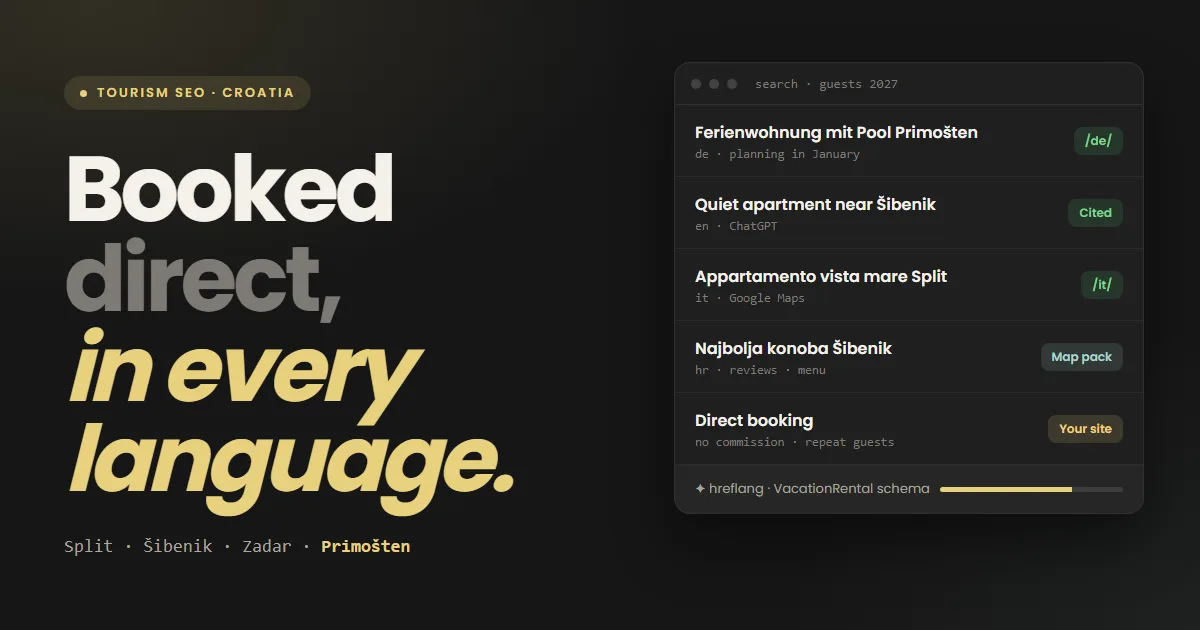
Guests plan a holiday in Croatia months in advance, and they search in their own language: on Google, on Google Maps and, increasingly, in ChatGPT and other AI assistants. Whoever has a fast, multilingual website and a well-kept Google profile gets found and booked directly. Everyone else leaves the field to the portals.
Below are the points we check first when we do tourism SEO in Croatia for rentals, restaurants and tour operators.
Why your own website matters next to Booking.com and Airbnb
Booking.com, Airbnb and similar portals bring reach, and for most rentals they belong in the mix. But every portal booking costs a commission, the portal sets the rules, and guest contact runs largely through its system, which makes it harder to invite guests back directly.
Holiday rental SEO starts with a website of your own, where guests who already know you, or found you on Google, book without a middleman, and where you decide on photos, prices and wording. The goal is not to leave the portals, but to stop depending on them alone.
Guests search in their own language
A family from Munich searches in German, a couple from Milan in Italian, guests from Warsaw, Prague, Ljubljana or Amsterdam in Polish, Czech, Slovenian or Dutch. Google shows them pages in their language first. A site that only exists in Croatian and English, with a translation widget on top, is largely invisible to them. What works is a real multilingual website:
- Own URLs for each language, such as
/de/,/it/or/pl/, so Google can index every version. - hreflang tags that link the language versions, so the guest from Vienna lands on the German page.
- Translated meta titles and descriptions, which people see in the results before they click.
- A native speaker’s check, at least on the pages that sell: home, accommodation or menu, prices, contact.
A widget that swaps the text in the browser creates no indexable pages: for Google, those languages do not exist. We build multilingual websites with translated URLs and hreflang from day one.
Google Business Profile and Maps: often the first contact
For restaurants, konobas, beach bars, excursions and boat tours, the Google Business Profile often matters more than the website. Someone standing in Šibenik’s old town at seven in the evening opens Maps, not a search page. What helps:
- The right categories: a precise primary category, such as seafood restaurant, boat tour agency or holiday apartment, plus fitting secondary ones.
- Seasonal opening hours: keep them current and mark closures clearly, so nobody stands at a locked door in November.
- Photos and menu: real pictures of the terrace, dishes, boat and view, and the menu, ideally in several languages.
- Reviews with replies: answer reviews, where possible in the guest’s language. Future guests read the replies too.
Our local SEO checklist walks through the profile step by step.
Seasonality: do the work in winter, not in June
Many guests book their summer holiday in winter and spring, early bookers from Germany and Austria among them. Update prices and photos only in June, and you show up when most decisions have already been made.
Our rule of thumb: between January and April your website and profile should be season-ready, with new prices and availability, current photos, events and opening dates. Search engines also need time to pick up changes.
Content that guests and AI assistants actually use
Most holiday websites say “beautiful apartment with sea view”. Guests and AI assistants want concrete answers. Write down what guests ask you every season:
- Getting there: distance and driving time from Split or Zadar airport, ferries to the islands, parking.
- Location: the nearest beach in metres, supermarket, bakery and restaurant, distance to the old town.
- What is included: air conditioning, Wi-Fi, towels, final cleaning, tourist tax, and for excursions fuel or lunch.
- Rules and times: check-in and check-out, pets, children, accessibility, and for tours the departure time and meeting point.
ChatGPT, Perplexity and Google’s AI Overviews quote exactly this kind of specific, factual content when someone asks “how far is the apartment from the beach?” or “is the boat trip suitable for small children?”. Vague marketing copy gives them nothing to cite. Our Mignuti Chatbot can answer such questions on your website in twelve languages.
Structured data: facts machines can read
Structured data (schema.org markup) describes your business in a format search engines and AI systems read without guessing. For tourism, the key types are:
- LodgingBusiness or VacationRental for apartments, villas and small hotels: address, coordinates, rooms or guests, amenities, check-in times.
- Restaurant for restaurants and konobas: opening hours, menu link, cuisine via
servesCuisine, price range. - TouristTrip or Event for excursions, boat tours, wine tastings or concerts: itinerary, dates, times and location.
Not every type earns a visible extra in Google’s results, but consistent markup helps Google and AI assistants tie your website, Maps listing and portal profiles to one business.
Mobile speed: the beach is not an office
Guests open your website on their phone: in the car, on the ferry, on the beach with weak Wi-Fi, or on paid roaming if they come from outside the EU. A slow page loses them to the next result.
The usual brakes: heavy page builders, slider galleries with dozens of full-size photos, autoplay videos and forgotten plugins. Lean, static websites with compressed images load fast even on a weak signal. We build them with Astro and aim for Lighthouse scores of 95 and above.
GEO: when guests ask ChatGPT instead of Google
More and more guests ask an AI assistant directly: “quiet apartment with a pool near Primošten”, “best konoba in Šibenik”, “boat trip to the Kornati from Murter”. ChatGPT, Perplexity or Google’s AI reply with a handful of recommendations, often with links. Optimising for these answers is called GEO, Generative Engine Optimization. We explain the basics in What is GEO?
For tourism businesses the biggest lever is consistency. AI assistants compare what they find on your website, in your Google profile, on TripAdvisor, on booking portals and on the site of the local tourist board (turistička zajednica). If name, address, distance to the beach and opening hours match everywhere, you become a source that can be cited with confidence. If the website says 200 metres to the beach and the portal says 400, the assistant has a reason to recommend someone else.
Your SEO agency in Croatia: from Dalmatia, for Dalmatia
We know tourism from our own projects. For Villa Five K, a luxury villa rental in Croatia, we built a multilingual Astro website with direct booking; for Adriatic Moments, a wedding photographer in Croatia, a multilingual website as well.
Mignuti Media is a small agency run by Eduard Ditler, with more than 20 years of experience and over 30 shipped projects. Our legal seat is Lahnstein near Koblenz in Germany, our second base Primošten in Dalmatia. We visit businesses in Primošten, Šibenik, Split, Trogir and nearby in person; everything else works remotely, in English, German or Croatian.
Whether you need a new multilingual website, a tidy Google profile or an SEO and GEO setup before the next season: see what we offer as an SEO agency in Croatia, or get in touch and tell us about your rental, restaurant or tour.
Frequently asked questions
Do I still need my own website if I am listed on Booking.com and Airbnb?
Yes, if you want direct bookings and repeat guests. Portals bring reach, but they charge a commission and control most of the contact with the guest. Your own website is where guests who already know you can book without a middleman.
Is a translation plugin enough for a multilingual holiday rental website?
Usually not. Widgets that translate the text only in the browser create no pages Google can index. Each language needs its own URLs, hreflang tags and translated meta titles and descriptions.
When should I update my website for the summer season?
Between January and April. Many guests plan and book in winter and spring, and search engines need time to pick up new prices, availability and content.
How do I get my apartment or restaurant recommended by ChatGPT?
Publish specific facts such as location, distances, what is included and opening hours, and keep them identical on your website, Google Business Profile, booking portals and the tourist board website. AI assistants prefer sources whose details match across the web.