
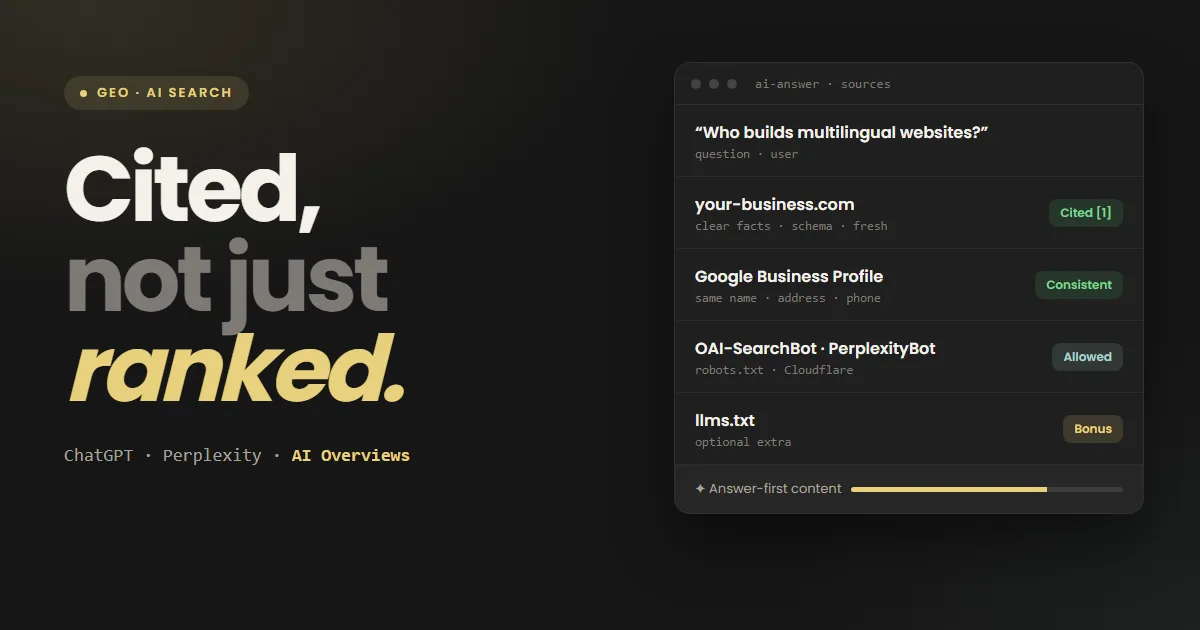
GEO, short for generative engine optimization, means optimising a website so that AI answer engines such as ChatGPT search, Perplexity, Google AI Overviews and AI Mode, Claude, Microsoft Copilot and Gemini can find it, understand it, trust it and cite it as a source. Instead of competing for one of ten blue links, you compete to be the passage an AI quotes when someone asks about your field. GEO builds on classic SEO, it does not replace it.
More and more people ask an assistant first: “Who does chip tuning near Koblenz?”, “Which wedding photographer in Split speaks German?”. The answer names a handful of sources. Below we explain how those sources are chosen and how to become one, based on our SEO & GEO work for clients and on our own domain.
SEO vs GEO: what stays the same, what changes
What stays the same
- Crawlability and indexing: a page that no crawler can reach cannot be cited. Google’s documentation states that AI Overviews and AI Mode have no additional technical requirements: the page must be indexed and eligible to be shown with a snippet.
- Fast, clean HTML: many AI crawlers do not run JavaScript, so content that only appears after scripts load may be invisible to them. That is one reason we build with Astro.
- Good content: useful, accurate, written by someone who knows the subject.
What changes
- Answers instead of ten links: the user gets a summary, and your page is either part of it or absent from it.
- Citations instead of rankings: there is no stable position one to ten. The same question can bring up different sources tomorrow, or in another engine.
- Fewer, better-qualified clicks: many questions are settled inside the answer. People who still click through have usually read about you already.
- Entity clarity matters more: an AI has to be sure who you are before it recommends you. Three name variants and two phone numbers make that harder.
How AI answer engines choose their sources
The details differ by provider and none publishes its exact weighting, but the basic process is well documented:
- Retrieval: the question becomes one or more searches, run against an existing index such as Google’s or Bing’s, the provider’s own crawlers, or both. Google calls its approach “query fan-out”: one question is split into several related searches.
- Selection: the model picks passages that answer the question clearly. A short, self-contained paragraph with a concrete fact beats a long introduction.
- Trust: specific beats vague, current beats outdated, and a source described consistently across the web (website, business profiles, directories, reviews, press) beats one full of contradictions.
- Answer: the model writes its answer and links the few sources it relied on.
A practical GEO checklist
1. Let the right bots in
If ChatGPT, Claude or Perplexity cannot fetch your pages, they cannot cite them. Check your robots.txt and your CDN: Cloudflare, for example, can block AI crawlers with a single switch. Which bots to allow is covered in Should you block AI bots?. Note that Google AI Overviews and AI Mode use the normal Googlebot, so the Google-Extended token does not affect them.
2. Structure pages answer-first
Answer first, details second. Use headings that match the questions your customers actually ask, and write passages that still make sense when quoted on their own. Lists and steps help. A wall of marketing copy does not.
3. Make your entity unambiguous
Add structured data (JSON-LD) for Organization or LocalBusiness, Person, Service, Article and FAQPage. Use the same name, address and phone number everywhere and connect your profiles with sameAs links. That guarantees no citation, but it removes the guesswork about who you are.
4. Keep your profiles consistent
Your Google Business Profile, Bing Places, LinkedIn, industry directories and booking platforms should match your website: same name, same opening hours, same services. Our local SEO checklist for small businesses covers this step by step.
5. Publish citable specifics
AI engines quote facts, not adjectives. “High-quality service at fair prices” cannot be quoted. Price ranges, dates, process steps, distances and the places you serve can. A holiday villa that states the walking time to the beach and the minimum stay in August gives an engine something to work with.
6. Go properly multilingual
AI answers in the user’s language, and the searches behind the answer often run in that language too. An English-only page competes poorly for a question asked in German or Croatian. Real translated pages with their own URLs and hreflang beat a translation widget, as our article on tourism SEO in Croatia shows.
7. Earn mentions and reviews elsewhere
AI engines do not rely on your website alone. Reviews, directory entries, local media coverage and links from partners help confirm that you exist, what you do and that customers are happy with it.
8. Optional: publish an llms.txt
llms.txt is a plain-text file that summarises your site for language models. It is a proposal, not an official standard, and not a confirmed ranking or citation factor. It costs little, so we publish one ourselves at mignuti.com/llms.txt. A cheap extra, not a strategy.
How to measure GEO
There is no single GEO dashboard yet. We combine four sources:
- Manual checks: list the ten to twenty questions your customers really ask, put them to ChatGPT, Perplexity, Gemini and Google AI Mode regularly, and note whether and how you are cited.
- Referral traffic: look for visits from chatgpt.com, perplexity.ai, copilot.microsoft.com and gemini.google.com in your analytics. ChatGPT often tags its links with
utm_source=chatgpt.com. - Crawler activity: Cloudflare AI Crawl Control and similar tools show which AI bots visit your site and whether their requests succeed.
- Google Search Console: appearances in AI Overviews and AI Mode are included in the normal performance report, not shown separately. Watch the trend for your key queries.
AI answers fluctuate, so a single test is only a snapshot. A log kept over weeks and months shows the trend.
How we do SEO and GEO at Mignuti Media
Mignuti Media is a small SEO and GEO agency run by Eduard Ditler: more than 20 years of experience, over 30 shipped projects, and a certified AI manager with proof of AI literacy under Article 4 of the EU AI Act. We work remotely for clients worldwide in English, German and Croatian, and in person around Koblenz, from our seat in Lahnstein, and in Dalmatia, from our second base in Primošten.
We test everything above on our own site first: a robots.txt open to answer, search and training bots, a few aggressive bots blocked via Cloudflare AI Crawl Control, an llms.txt, JSON-LD on every page, and every page in three languages with hreflang. For clients we start by taking stock of technical SEO, structured data, business details, AI crawler access and how AI answers describe you today. Our references include a relaunch with local SEO for AE Performance, a chip-tuning workshop in Koblenz, and multilingual websites for Villa Five K and Adriatic Moments in Croatia.
Curious how AI describes your business today? See our SEO & GEO service and AI crawlers & visibility, or simply get in touch.
Frequently asked questions
What is the difference between SEO and GEO?
SEO optimises a website to rank in classic search results. GEO optimises it to be cited as a source in AI-generated answers from tools such as ChatGPT, Perplexity and Google AI Overviews. GEO builds on SEO: without crawlability, indexing and good content there is nothing to cite.
Does GEO replace SEO?
No. AI answer engines draw on search indexes and their own crawlers, so a technically sound, well-indexed website remains the foundation. GEO adds answer-first pages, a clear entity, citable specifics and consistent profiles on top.
Do I need an llms.txt file for GEO?
It is not required. llms.txt is a proposal, not an official standard, and it is not a confirmed ranking or citation factor. Because it is cheap to create, we treat it as an optional extra.
How can I tell whether AI engines cite my website?
Regularly ask the questions your customers ask in ChatGPT, Perplexity, Gemini and Google AI Mode and note whether you are cited. In addition, check your analytics for referrals from chatgpt.com, perplexity.ai, Copilot and Gemini, and watch AI crawler activity, for example in Cloudflare AI Crawl Control.